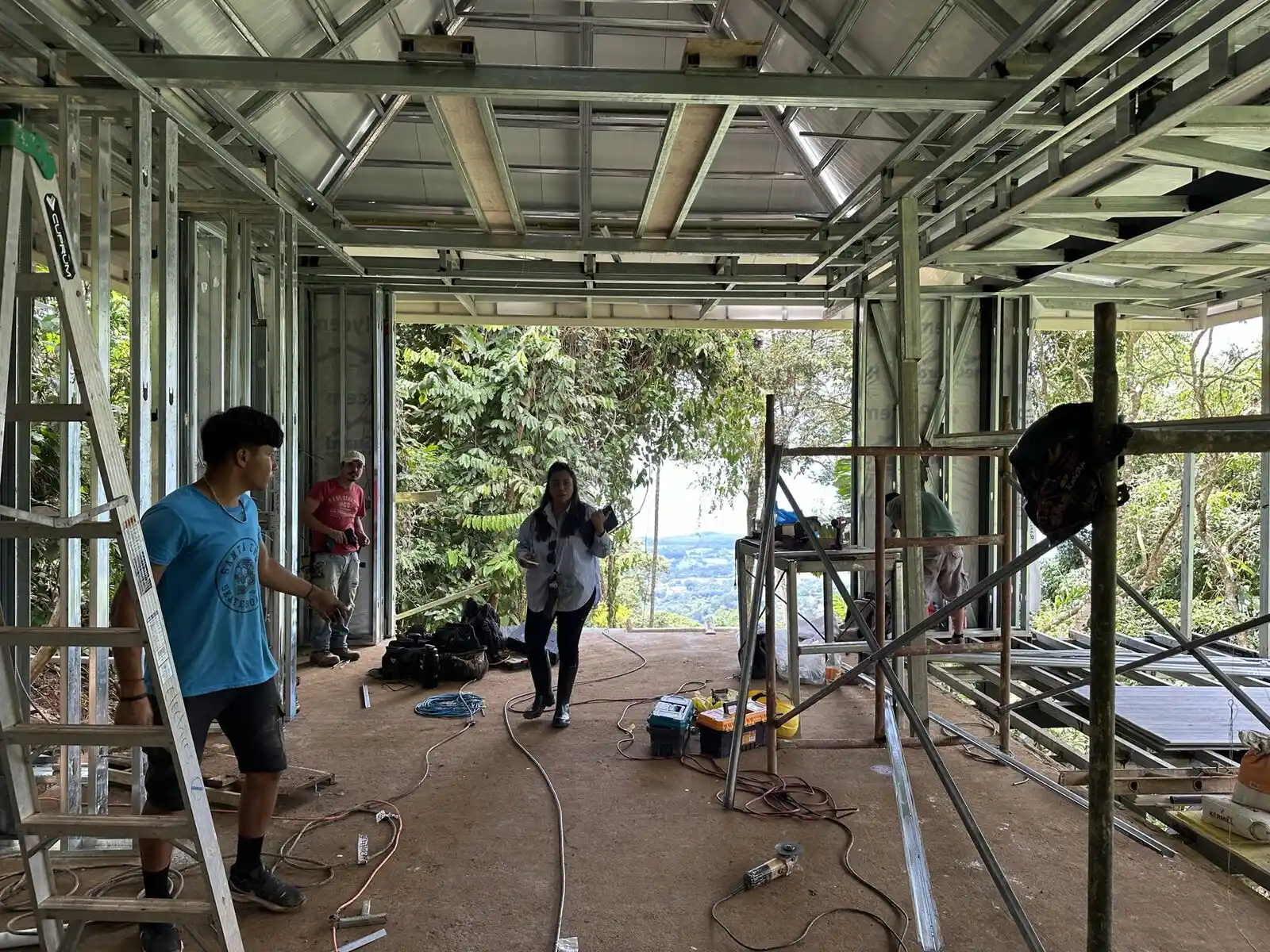
We built four luxury villas in the Costa Rican rainforest by hand, through rain, and against reason.
Speed and quality aren’t opposites. They’re twins born from alignment. But alignment only comes through chaos.
Setting the Scene
Deep in the jungle of Uvita, Costa Rica, sits Rancho Pacífico, a luxury retreat perched on a ridge where mist rolls through every afternoon.
Our task sounded simple on paper: design and build four new villas and renovate the two existing buildings in under five months before high season starts.
Except nothing in the Costa Rican rainforest is simple. The slope was steep, access was minimal, and half my site visits ended soaked to the bone.
Yet somehow, we pulled it off. Here’s what we learned, and what nearly broke us in the process.
Lesson 1 · Don’t Flatten the Land. Let It Teach You.

In Europe or the US, the instinct would be to flatten the hill before starting.
In the tropics, that’s a recipe for disaster. Flattening land here only makes water runoff, erosion, and drainage worse.
Our site was so steep that some of the structural columns reached six meters high before the floor even began.
Instead of fighting gravity, we elevated the villas on steel stilts, letting rainwater and air flow naturally beneath. The forest remained intact, and the architecture felt like it belonged to it.
The more you fight the land, the more it punishes you.
Takeaway:
-
Slopes are not obstacles; they are natural drainage systems.
-
Elevate, don’t excavate.
-
Building lightly often means building smarter.
Lesson 2 · Prefabricate What You Can, Then Carry It by Hand

A truck couldn’t reach the site. Everything, from steel beams to bathroom tiles, had to be carried 200 meters through the jungle by hand.
Most of the steel frame was prefabricated in the shop, labeled, and delivered in pieces small enough for two people to lift.
It looked insane at first, but it worked.
Prefabrication meant precision, and carrying it by hand meant commitment. The structure rose like a giant Meccano set in the forest, one beam at a time.
Takeaway:
-
Logistics shape architecture more than design does.
-
Plan for transport before you plan the structure.
-
If it can’t be carried in, it can’t be built.
Lesson 3 · The Rain Will Win, So Work With It

It rained every week. Sometimes every day.
The rain didn’t just slow progress, it made the project more expensive. You pay for downtime here. Crews wait. Deliveries stop. Materials soak.
But the key is this: once you get a roof over your structure, you’ve won half the battle. From there, progress accelerates.
I still remember the first day the roof went up. It felt like conquering Everest.
Takeaway:
-
Weather isn’t an excuse; it’s a condition.
-
Build roofs early.
-
Budget for rain delays, and for the mental ones too.
Lesson 4 · Changes Are the Death of a Fast Project

We had many.
Some were brave. Some were beautiful. Some were chaos.
The owners made several design changes during construction, and while I admire their courage, each one rewrote the schedule.
For example, I fought for black bathroom tiles from day one. It took four months, two plan revisions, and a last-minute call during construction to finally get approval.
Installing thousands of those tiny black rectangles was tedious, but the result was worth it.
Bathrooms in Costa Rica are often bland. These feel monastic and serene.
Design needs courage. Building needs discipline.
Takeaway:
-
Every change has a price, and it’s rarely just money.
-
Great design needs conviction early.
-
Bold choices are worth it, but pick your battles.
Lesson 5 · Communication Is Everything

This project cost over one million dollars and was built in less than five months. That speed doesn’t happen by luck.
We had a strong contractor, which is rare in Costa Rica, but that alone isn’t enough.
If the architect doesn’t deliver detailed drawings, daily coordination, and constant problem-solving, the system collapses.
Communication was relentless: drawings, calls, meetings, soaked site visits, and endless messages. One missed conversation could have derailed the entire plan.
Takeaway:
-
Speed is earned through coordination, not pressure.
-
A good contractor is gold, but an aligned architect makes it possible.
-
Talk more than you think you need to.
Regrets and Realities

Of course there are regrets.
Tight schedules always leave scars. Some of the interior doors were designed too late, which limited our material choices.
The deck finish could have been more durable.
And then there are the small things no one else sees, but that the architect can’t unsee.
Still, when I stand there now, under the laurel ceiling with rain echoing softly above, I feel proud.
The imperfections are part of the story. The jungle doesn’t do perfect anyway.
Final Thoughts

Rancho Pacífico learned us that in the tropics, perfection is impossible. Adaptation is the real skill.
It’s about aligning people, purpose, and process. And the jungle will always have the last word.
Written by Matt Usher
Architect and co-founder of Studio Octava, Costa Rica.
We design healthy, tropical, and uniquely crafted homes and retreats across the country.
www.studiooctava.com
Gallery